
SEO vs AEO vs GEO: the complete 2026 guide to ranking on Google, ChatGPT & AI search
Ranking on page one is no longer enough. Search engines and AI assistants now answer the question before the visitor clicks. This guide breaks down SEO vs AEO vs GEO — what each one does, why you need all three, and how to show up across Google, ChatGPT, Gemini, Perplexity and AI Overviews.
SEO vs AEO vs GEO: search vs AI search in 2026
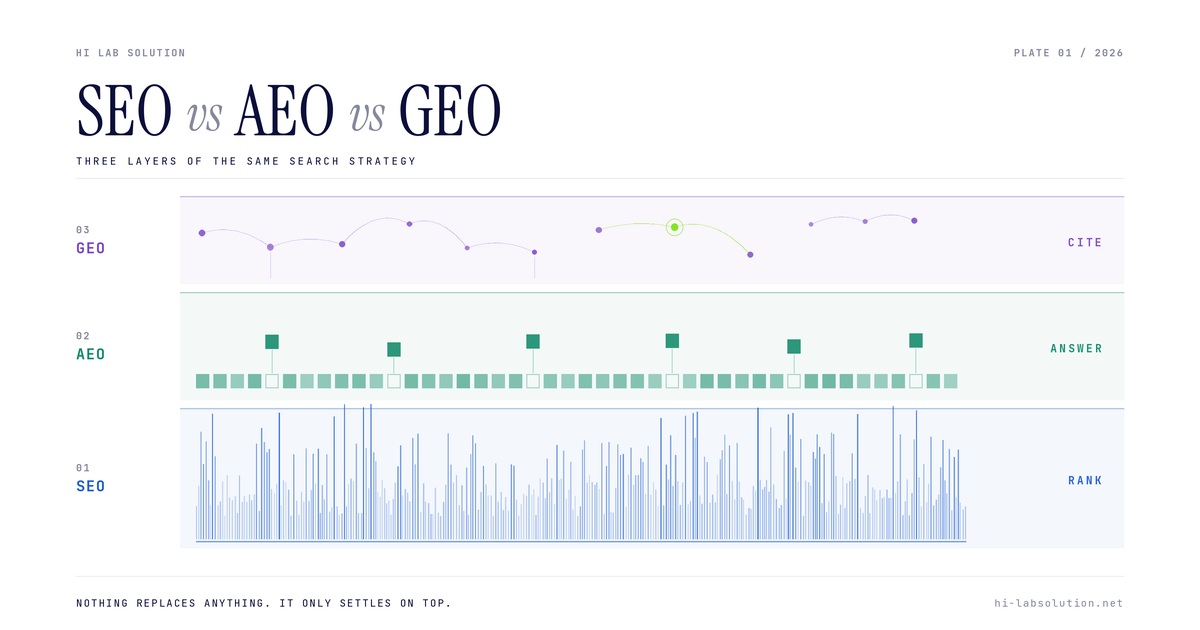
SEO vs AEO vs GEO is the question defining search strategy in 2026. Search is no longer just about ranking a page on Google. Today, brands need visibility across traditional search results, AI Overviews, featured snippets, and generative AI tools such as ChatGPT, Gemini, Perplexity, and Copilot.
That shift has created confusion around three overlapping disciplines: SEO, AEO, and GEO. They are related, but they are not the same, and businesses that treat them as separate silos often miss the bigger opportunity.
The better approach is to think of SEO vs AEO vs GEO not as a choice, but as a stack. SEO helps a website rank and get discovered. AEO helps content become the answer. GEO helps a brand become the source that AI systems mention and cite.
For a global business, this matters whether the audience is in New York, London, Dubai, Singapore, or Delhi. For an Indian brand, it matters even more because competition is rising across local search, ecommerce search, and AI-assisted discovery at the same time.
Six years, three disciplines
How answer engines and generative search have grown alongside traditional SEO — the numbers illustrate the shift in optimization focus, not absolute traffic share.
What you’ll learn in this guide
- The fundamental differences between SEO, AEO, and GEO
- Why all three strategies are essential in 2026
- A unified framework for implementing all three approaches
- Specific tactics for enterprises, SaaS companies, and SMBs
- Technical foundations that support all three strategies
- How to measure success beyond traditional keyword rankings
What is SEO in 2026?
In practical terms, SEO helps a website appear in traditional search results when users type a query into Google or another search engine. It still matters because search engines remain the starting point for millions of buying journeys, research tasks, and comparison searches.
But SEO alone is no longer enough. A page can rank well and still lose attention if an AI Overview answers the question first or if an AI assistant cites a competitor instead.
The paradigm shift
The traditional search funnel gave way to a multi-dimensional model where a single query can produce a rank, an answer, and a citation — often all at once.
Traditional SEO
- Heavy reliance on exact-match keywords
- Backlink quantity over context
- Traffic requires an explicit click-through
The tri-layer approach
- Focus on entities, context, and natural language
- Citations in AI Overviews are key discovery points
- Zero-click visibility matters as much as traffic
What is AEO?
This is why concise definitions, FAQ sections, comparison tables, and short answer blocks have become more important. Content that feels easy to summarize is more likely to be selected when a search engine needs a quick, reliable answer.
For example, if an Indian ecommerce brand wants to rank for a query like “best ayurvedic hair oil in India,” SEO helps the category or guide page rank, but AEO helps the brand earn visibility when the engine wants to show a direct answer or summary above the traditional results.
Snippets vs AI overviews
How modern engines decide between extracting an exact quote and synthesizing a brand-new answer — and what you can do to be picked in each case.
Featured snippet
Best for clear-cut answers. The engine finds the most authoritative page and pulls the exact block that answers the query.
The top UI trends for AI apps include conversational interfaces, predictive layout shifts, dark mode optimization, and micro-interactions that signal when AI is processing data.
How to optimize
- Answer questions directly in 40–60 word paragraphs
- Use clear H2/H3 headings formatted as questions
AI overview
Best for complex, multi-layered queries. The AI reads multiple expert sources, synthesizes them, and writes a unique response with citations.
Designing for AI requires a shift in how we handle interactions. Focus on building trust through transparency and letting users guide or correct outputs1.
How to optimize
- Publish original data, opinions, and case studies
- Build deep topical authority over thin keyword pages
What is GEO?
Unlike traditional SEO, GEO is not just about ranking a page. It is about increasing the chance that a brand, statistic, framework, or explanation is referenced inside an AI-generated answer.
A SaaS company, for example, may still rank on Google for a category term, but its next growth opportunity may come from being named in AI-generated comparisons and recommendation-style answers. That is where GEO becomes strategically important.
How AI systems process & cite
A behind-the-scenes look at how modern tools understand intent, gather reliable facts, and give credit to sources.
Understanding intent
You ask a question. The system breaks down the meaning of your words to grasp the real intent, not just the keywords.
Scanning sources
The engine rapidly scans trusted sites and expert perspectives that match your exact intent.
Writing the answer
It writes a natural answer combining its knowledge with live facts, adding clickable references for you to explore.
AI-driven UI focuses on predictive flows1.
SEO vs AEO vs GEO — what’s the difference?
The simplest way to understand the difference is this: SEO helps a page rank, AEO helps a page answer, and GEO helps a brand get cited in AI responses.
| Dimension | SEO | AEO | GEO |
|---|---|---|---|
| Main goal | Rank in organic search | Become the direct answer | Become a cited source in AI answers |
| Primary surfaces | Search results and organic listings | Featured snippets, AI Overviews, PAA, voice | ChatGPT, Gemini, Perplexity, Copilot, Google AI |
| Core methods | Technical SEO, content, authority, UX | Direct answers, structure, formatting, FAQ, clarity | Entity clarity, authority, context, citation readiness |
In practice, businesses do not choose one and ignore the others. A solid 2026 strategy uses SEO as the base, AEO as the extraction layer, and GEO as the citation layer.
One system, three layers
Winning brands don’t pick one — they build a solid foundation and layer specialized optimization on top of it.
SEO — the base layer
The foundation of your digital house. It handles the heavy lifting — ensuring your site is technically flawless, loads fast, and covers topics deeply so search engines establish baseline trust.
AEO — the extraction layer
This is where you package your expertise. AEO structures your content into bite-sized, easy-to-read nuggets so smart devices and voice assistants can pull your direct answers immediately.
GEO — the citation layer
The peak of the modern strategy. GEO ensures that when AI systems synthesize massive amounts of data, they recognize your brand as the primary authority and link back to you as the definitive source.
Why SEO vs AEO vs GEO all matter together in 2026
The SEO vs AEO vs GEO debate matters because search behavior has changed. Users still search on Google, but they also rely on AI Overviews, ask direct questions to ChatGPT and Gemini, and use conversational tools for product research, software comparisons, and local recommendations.
This means a brand can lose visibility in several ways: by not ranking, by not being chosen as the answer, or by not being cited in generative responses. SEO solves the first problem, AEO improves the second, and GEO addresses the third.
A unified SEO vs AEO vs GEO framework for 2026
The most practical way to approach SEO vs AEO vs GEO is to stop treating them as separate projects and build one integrated system.
STEP 01Strengthen the SEO foundation
Technical crawlability, indexable pages, strong internal linking, relevant topic clusters, fast load speed, and pages that genuinely match search intent.
STEP 02Build answer-ready content
Create sections that define terms clearly, answer specific questions directly, and use structured formatting such as FAQ blocks, tables, lists, and short summaries.
STEP 03Build citation-ready authority
Use consistent entities, trustworthy brand context, useful examples, structured data, and content that is easy for AI systems to interpret and reuse accurately.
SEO vs AEO vs GEO for different business types
Enterprise and B2B brands
Enterprise teams should focus on content governance, topic ownership, and technical consistency across large websites development. The goal is to become the most trustworthy source on key commercial topics, not just another website competing for clicks.
For example, a global software brand should maintain strong category pages, comparison pages, use-case pages, documentation, and expert thought leadership that can be surfaced in both search and AI-generated summaries.
- Implement comprehensive content governance system
- Create authoritative category and comparison pages
- Develop expert thought leadership content
- Ensure technical consistency across all properties
SaaS and Tech companies
SaaS companies benefit from GEO when their frameworks, product categories, or expert explainers start appearing in AI-generated answers. They should create content that is precise, scannable, and rich in entities such as product type, buyer role, workflow, integration, and problem category.
- Create entity-rich product descriptions
- Develop framework-based content that’s easy to cite
- Build comprehensive comparison pages
- Implement structured data for all product features
SMB and Local businesses
Smaller businesses should not assume GEO is only for large brands. A local clinic, consultant, or ecommerce seller can still benefit by improving local SEO, adding clear service pages, using schema, and publishing high-clarity content that answers real customer questions.
An Indian clinic in Mumbai or Ahmedabad, for example, can improve visibility by combining location-specific service pages, FAQ content, and structured data so both search engines and AI tools better understand its services and relevance.
- Optimize Google Business Profile with detailed information
- Create location-specific service pages
- Add FAQ sections addressing common customer questions
- Implement local business schema markup
Technical foundations that support all three
All three layers of SEO vs AEO vs GEO share one technical base. Technical SEO remains critical because AI-friendly content still needs to be crawlable, indexable, and structurally clear. If the page is slow, hard to parse, or poorly linked, both search engines and AI systems will struggle to use it effectively.
The most useful technical upgrades include:
- Article and FAQ schema
- Clear heading hierarchy
- Strong internal links between related content
- Canonical control and clean indexability
- Mobile-friendly performance and Core Web Vitals improvements
AEO tactics that work
To improve answer visibility, structure matters almost as much as substance. Content should answer obvious questions directly, define important terms early, and avoid vague explanations that are hard to extract.
Effective AEO tactics include direct definition paragraphs, FAQ sections, short summary blocks, tables, and decision-support content that reduces friction for the reader.
A simple example is adding a 40 to 60 word definition under the heading “What is GEO?” so the page gives search systems a clean answer block to reuse.
Before and after optimization
How structural clarity turns the same content into an answer-ready asset.
Before — buried context
What is GEO?
When we look at the history of search, things have changed a lot. Back in the day, keywords were everything. Now, AI is taking over. So, if you are wondering about the new trends, Generative Engine Optimization is something you should know about.
It basically means that instead of just ranking for links, you are trying to make sure that ChatGPT and Google’s AI overviews actually mention your brand when they generate an answer for the user…
After — answer-ready
What is GEO?
- Focuses on entities and facts
- Targets AI overviews and chatbots
GEO tactics that work
GEO works best when content is easy to trust and easy to cite. That means each important paragraph should have one clear idea, key terms should remain consistent, and examples should connect concepts to real business outcomes.
It also helps to make relationships explicit. For example, instead of vaguely saying “structured data helps,” the article should explain that structured data improves machine understanding, which supports both answer extraction and citation clarity.
Brands should also publish content that demonstrates expertise rather than just repeating definitions. Frameworks, examples, comparison logic, and nuanced recommendations are more useful to AI systems than generic filler content.
What to measure in 2026
Measuring SEO vs AEO vs GEO means teams should not rely only on keyword rankings. Modern measurement should include organic traffic, featured snippet visibility, AI Overview presence, branded mentions in AI tools, and qualitative checks of how often the brand is cited or recommended in generative responses.
For enterprise teams, this may mean adding AI visibility tracking into existing reporting. For SMBs, even manual checks across Google AI, ChatGPT, Gemini, and Perplexity can reveal where visibility is improving or where new content is needed.
Check your AI search readiness in 30 seconds
Answer six quick questions about your website. Your score updates live and shows exactly which layer — SEO, AEO, or GEO — needs attention first.
AI search visibility ROI calculator
Estimate the potential impact of improving your AI search visibility.
Test your knowledge
Think you understand SEO vs AEO vs GEO? Take this quick check.
Which optimization strategy focuses primarily on getting your brand cited in AI-generated answers from ChatGPT, Gemini, and similar tools?
Final takeaway on SEO vs AEO vs GEO
The honest answer to SEO vs AEO vs GEO is that SEO is still the foundation, but it is no longer the full strategy. In 2026, the winning brands build content that can rank in search, answer directly in AI-powered results, and earn citations from generative engines at the same time.
That is why the most effective approach is not SEO or AEO or GEO. It is a unified model where all three work together, shaped around the same customer questions, the same technical foundation, and the same authority-building strategy.
Frequently asked questions
What is the difference between SEO, AEO, and GEO?
SEO (Search Engine Optimization) focuses on improving your website’s rankings in traditional search results. AEO (Answer Engine Optimization) focuses on structuring your content to be extracted as direct answers in featured snippets, AI Overviews, and voice responses. GEO (Generative Engine Optimization) focuses on making your content easy for AI systems like ChatGPT and Gemini to understand, trust, and cite in their generated answers.
Is AEO replacing SEO in 2026?
No, AEO is not replacing SEO. Instead, it’s complementing it. SEO remains the foundation of digital visibility, ensuring your content is discoverable and ranks in traditional search results. AEO builds on this foundation by making your content more extractable for direct answer features.
How does GEO help brands appear in AI answers?
GEO helps brands appear in AI answers by making content more trustworthy and citable for AI systems. This includes using consistent entity terminology, providing clear context and relationships between concepts, demonstrating expertise through frameworks and examples, and ensuring content is structured in a way that AI systems can easily interpret and reference accurately.
Do businesses still need SEO if they invest in GEO?
Yes, businesses absolutely still need SEO even if they invest in GEO. SEO ensures your content is discoverable, crawlable, and ranks in traditional search results. GEO builds on this foundation by increasing your chances of being cited in AI-generated answers, but without SEO, your content may not even be considered by AI systems in the first place.
How can Indian businesses adapt to AI search?
Indian businesses can adapt to AI search by focusing on three key areas: 1) Strengthening their technical SEO foundation to ensure content is crawlable and indexable, 2) Creating answer-ready content with clear definitions, FAQs, and structured formatting, and 3) Building citation-ready authority through consistent entity usage, expert content, and structured data.
Which schema markup helps AEO and GEO?
Several types of schema markup support both AEO and GEO: Article schema helps search engines understand your content structure, FAQPage schema makes your questions and answers more extractable, HowTo schema provides step-by-step instructions that can be featured in AI answers, and Organization/Person schema establishes authority and trustworthiness.
Ready to show up everywhere search is happening?
Don’t let your competitors win in AI search. Get a customized strategy that integrates SEO, AEO, and GEO for maximum visibility across every channel.


Recent Comments